
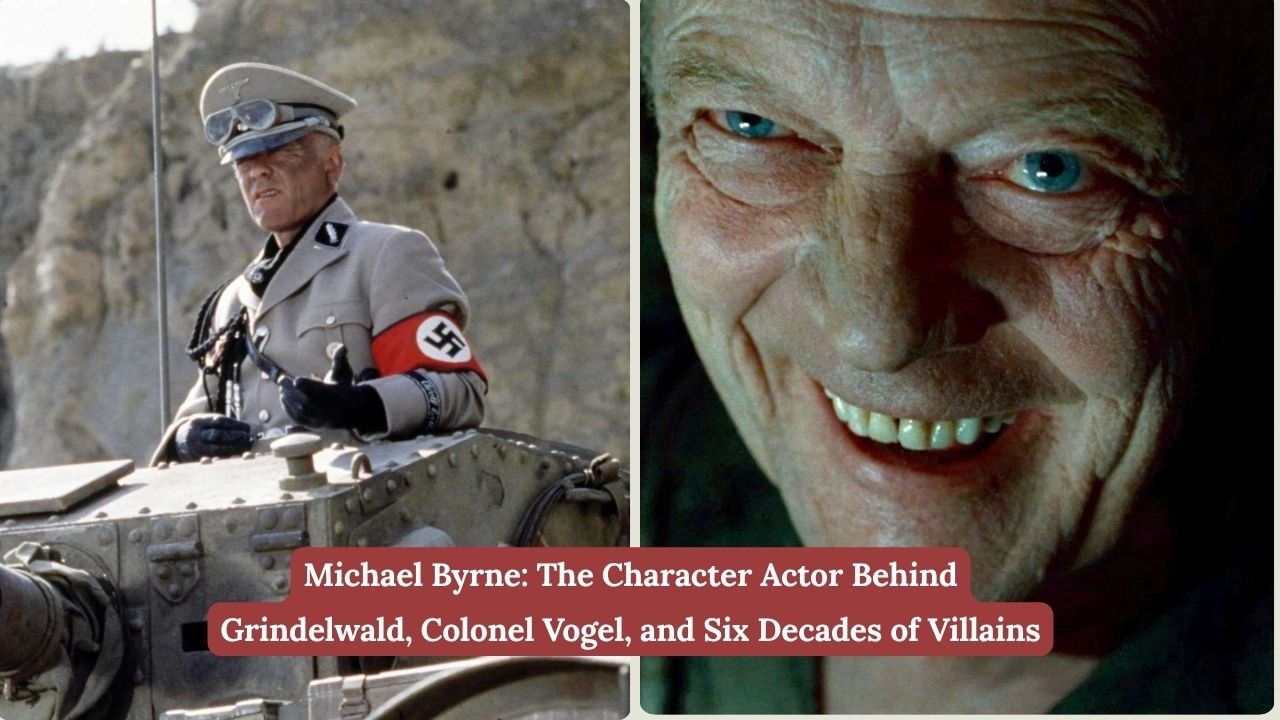
If you’ve watched a Harry Potter finale, an Indiana Jones adventure, or an Oscar-winning Braveheart, you’ve seen Michael Byrne even if you never learned his name. That was the quiet genius of the British character actor: he made the stars around him look better, then vanished back into the ensemble. Over a career spanning more than sixty years and 160-plus screen credits, Byrne built one of the most dependable résumés in British film, television, and theatre. He died on 20 June 2026 at the age of 82.
This is a look back at the roles, the range, and the reason a working actor became a familiar face to millions.
From a National Theatre stage to the screen
Michael Byrne was born on 7 November 1943 in Hampstead, north London. He trained at the Central School of Speech and Drama and, still in his early twenties, joined Laurence Olivier’s newly formed National Theatre Company in the 1960s sharing a stage with Olivier himself and a young Maggie Smith. It was a starting point most actors only dream of, and it shaped the disciplined, commanding presence that would define his screen work.
The theatre never left him. Across his life he returned again and again to the stage, taking on Shakespeare and modern drama alike from Much Ado About Nothing and The Cherry Orchard to Death and the Maiden at the Royal Court. Remarkably, in 2010, at age 66, he played Romeo opposite Siân Phillips’s Juliet at the Bristol Old Vic, a piece of casting that says everything about how his peers viewed his range.
Michael Byrne: Image Credit goes to original owner
The 1970s: a specialist in men in uniform
Byrne’s screen breakthrough came through a run of war epics in the 1970s, where his cool authority made him a natural fit for military officers frequently German ones. He appeared in The Eagle Has Landed (1976), Richard Attenborough’s A Bridge Too Far (1977), and Force 10 from Navarone (1978). That last film is a fun piece of trivia for movie fans: it paired Byrne with a young Harrison Ford more than a decade before the two would face off again in far more famous circumstances.
Colonel Vogel: the Indiana Jones villain audiences remember
For many, Byrne’s defining role arrived in 1989 as Colonel Ernst Vogel in Steven Spielberg’s Indiana Jones and the Last Crusade. As the ruthless Nazi officer who tangles with Harrison Ford’s Indy and meets a memorable end in a run-in with a tank Byrne delivered the kind of crisp, menacing antagonist the franchise thrived on. It remains one of his most recognised performances and a reunion, of sorts, with his Force 10 co-star.
Grindelwald: the wizard before Depp and Mikkelsen
Two decades later, Byrne stepped into a corner of the wizarding world that fans still discuss. In Harry Potter and the Deathly Hallows Part 1 (2010), he played an older Gellert Grindelwald the once-powerful dark wizard defeated by Dumbledore and imprisoned in Nurmengard, the very fortress he’d built for his enemies. In a brief but pivotal scene, a frail Grindelwald refuses to help Voldemort locate the Elder Wand.
Here’s the connection casual viewers often miss: this is the same Grindelwald later played by Johnny Depp, and then Mads Mikkelsen, in the younger, flashier Fantastic Beasts films. Byrne’s version is the endpoint of that arc the ambitious wizard reduced to a prisoner facing his past. It’s a small role that gains real weight once you know where the character’s story eventually goes.
Braveheart, Bond, and a run of prestige films
Byrne’s filmography reads like a tour through decades of notable cinema. In Mel Gibson’s Braveheart (1995), he played Smythe, the English soldier whose brutality helps set William Wallace on his path to rebellion. In the James Bond entry Tomorrow Never Dies (1997), he appeared as Royal Navy Admiral Kelly. He turned up in Bryan Singer’s Apt Pupil (1998) as a concentration-camp survivor instrumental in exposing a hidden Nazi war criminal, and he worked with Martin Scorsese on Gangs of New York (2002). Other credits include The Saint, The Good Father, and The Sum of All Fears a body of work that put him alongside many of the era’s biggest directors and stars.
A television regular in British homes
While film fans knew him as a villain, British television audiences knew him as a familiar, recurring presence. From 2008 to 2010, Byrne played Ted Page across 67 episodes of the long-running ITV soap Coronation Street the long-lost father of Gail Platt and former flame of Audrey Roberts. He later appeared in the BBC medical drama Casualty and popped up across staples like Midsomer Murders, Sharpe, and Hornblower. His final screen credit came in 2023.
The legacy of a “working actor’s actor”
Michael Byrne is survived by his wife, actress Carole Nimmons, whom he married in 1965; their daughters, Tara and Bryony; and three grandchildren, Tom, Chloe, and Jasmine.
What made Byrne special wasn’t top billing it was reliability of a rare kind. He could anchor a scene with a glance, project authority without raising his voice, and lend gravitas to a Nazi colonel, a dark wizard, or a soap-opera patriarch with equal conviction. In an industry built around stars, he was the steady professional who made everyone around him look better. Six decades of work, and a face millions recognised long before they knew the name that’s a legacy most actors would envy.
